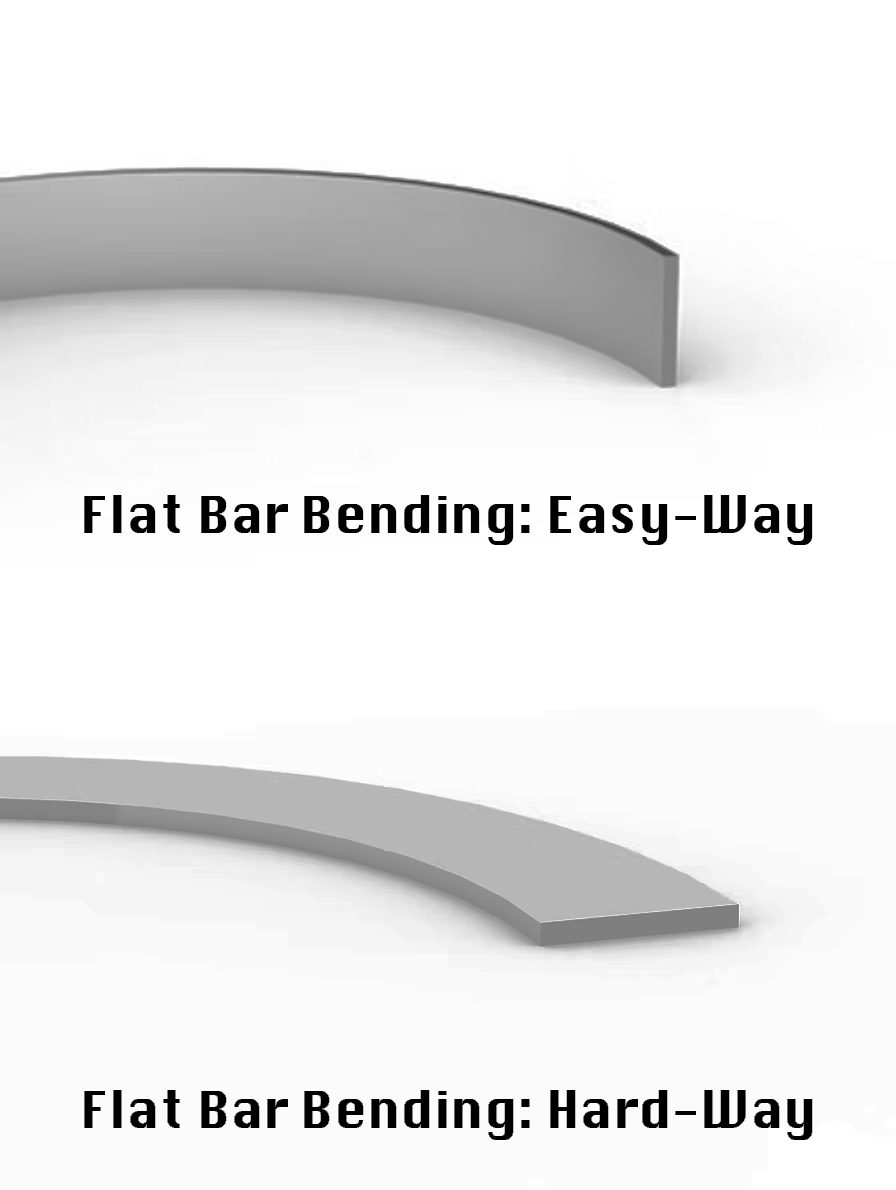
In the landscape of industrial metal forming, flat bar ring rolling is often misjudged as a simple mechanical task. However, to an experienced operator, bending a flat bar along its “hard way” (the thick edge) to create a flange is a high-stakes tug-of-war between yield strength and geometric stability. It is a process where the material doesn’t just bend—it protests.
The Rolling Dilemma: Confronting Material Instincts
When a flat bar enters a standard three-roll pyramid bender, physics immediately imposes a costly limitation: the unbent flat end. Due to the distance between the roll support points, the last 2 to 3 inches of the bar never enter the bending envelope. These stubborn straight sections are the “hidden tax” of production, forcing shops to either perform expensive pre-bending with a press or trim them off later, resulting in significant material waste.
The deeper struggle, however, is instability. In a “hard-way” roll, the internal stress field is violently lopsided: the inner radius is crushed under compression while the outer radius is stretched to its limit. This disparity gives the flat bar a natural impulse to twist or warp into a “pretzel” shape. You aim for a perfect circular flange, but the physics of the material may deliver a reject characterized by wavy edges or alligator cracking.
The Friction of Process: Scuffing and Springback
To maintain traction, conventional hardened steel rolls often feature knurling. While effective for grip, these rolls frequently leave deep gouges or “scuff marks” on the workpiece, necessitating costly secondary finishing. Furthermore, the reality of springback—that slight “rebound” as the metal leaves the rolls—makes achieving the final diameter in a single pass nearly impossible, often requiring tedious multi-pass sequences and post-process calibration.
The BIT Solution: The Secondary Revolution of the Rotary Roller Leveler
If the rolling machine gives a flange its “radius,” the BIT Rotary Roller Leveler gives it its “spine.”
It is crucial to understand that these are two distinct stages of a sophisticated workflow. While high-performance rollers like the PBC series can minimize flat ends through independent roll movement, the inherent residual stresses of a hard-way bend often leave the flange with micro-warps or a slight “dish” shape.
BIT provides the definitive answer with the Rotary Roller Leveler—a standalone machine designed specifically to terminate these residual stresses. Unlike traditional leveling equipment, the rotary leveler uses a series of precision-aligned work rolls that engage the flange as it rotates. Its logic is surgical:
- Neutralizing Internal Stress: It thoroughly releases the asymmetrical stresses built up during the rolling process.
- Restoring Planarity: It forces twisted or warped profiles back into a single, perfect horizontal plane, eliminating the “flip” or “wave” common in heavy flanges.
- Achieving True Circularity: By applying continuous, alternating pressure, it corrects “ovality” caused by inconsistent material hardness, ensuring a perfect circle.
In the BIT philosophy, a high-quality flange isn’t “pressed” out by a single machine; it is “refined” through a scientific process chain.
By utilizing the independent roll movement of a PBC machine to slash material waste, and following it with the BIT Rotary Roller Leveler, fabricators move beyond simple bending. This combination ensures that the finished flange is not just a circle in name, but a component that is perfectly flat, dimensionally true, and free from the geometric chaos of unmanaged stress. Flange production is no longer a gamble of trial and error—it is an exercise in engineering certainty.