Need to know how strong your angle iron is? Calculate section modulus in seconds.
The Angle Iron Section Modulus Calculator provides fast and accurate values for the bending strength of L-shaped angle profiles: Simply input your angle dimensions to determine the section modulus (Z).
This tool supports both metric (mm, mm³) and imperial (inch, in³) units.
Angle Section Elastic Modulus Calculator
Calculation Results
Moment of Inertia (Ixx): —cm⁴Moment of Inertia (Iyy): —cm⁴
Elastic Section Modulus (Sxx): —cm³
Elastic Section Modulus (Syy): —cm³
Plastic Section Modulus (Zxx): —cm³
Plastic Section Modulus (Zyy): —cm³
Cross-sectional Area (A): —cm²
Formulas for angle sections:
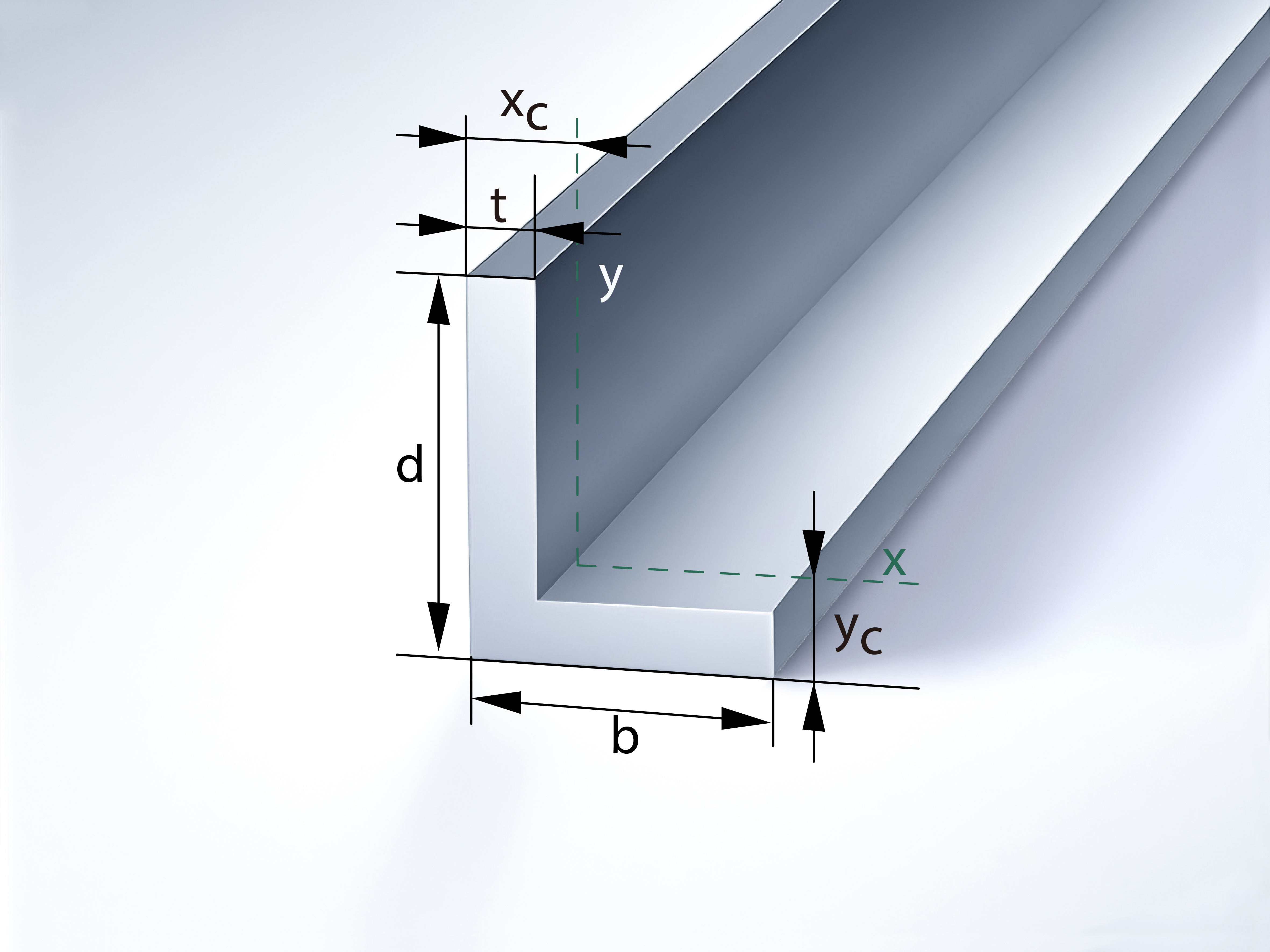
Ixx = (1/3)(b*d³ – (b-t)(d-t)³) – A*(d-yc)²
Iyy = (1/3)(d*b³ – (d-t)(b-t)³) – A*(b-xc)²
S = I/y | Z ≈ 1.5×S (plastic modulus approximation)
A = (b + d – t)*t
What is the Elastic Section Modulus of an Angle Iron?
The elastic section modulus of an angle iron is a geometric property used to evaluate its bending resistance under load. It plays a crucial role in the design and analysis of structural members, frames, and metal profiles.
About Angle Iron Geometry:
Angle irons typically have an L-shape cross-section, either equal leg (e.g. L50×50×6) or unequal leg (e.g. L75×50×6). Due to their asymmetry, section modulus values depend heavily on the bending axis and orientation.
Section Modulus for Common Bending Axes:
- X–X Axis: Bending about the horizontal leg (web-down orientation)
- Y–Y Axis: Bending about the vertical leg
- Z–Z Axis (diagonal): Complex torsional/biaxial bending
Since angle irons have unsymmetrical shapes, exact section modulus values are determined from standard steel tables or calculated using moment of inertia and distance from the neutral axis:
S = I / c
Where:
S = Elastic section modulus
I = Moment of inertia
c = Distance from neutral axis to extreme fiber
Application:
Section modulus is used in flexural stress analysis via:
σ = M / S
Where:
σ = Maximum bending stress
M = Bending moment
S = Section modulus (mm³ or in³)
Use this calculator to estimate the section modulus of angle irons in various orientations, supporting both metric and imperial units.
Need weight per meter or foot before bending? 👉 Use Our Angle Iron Weight Calculator. See how your angle iron is bent into curves and structures: 👉 View Angle Profile Bending Methods
Key Features: 🧮 Calculates section modulus (Z) for L-shaped angle iron profile, 📏 Supports equal and unequal leg dimensions, 🔁 Metric (mm³) and imperial (in³) units, ⚙️ Suitable for structural design, stress analysis, and profile bending.
✅ How to Use
Choose your preferred unit system: mm or inch;
Enter: Leg A (vertical leg);
Leg B (horizontal leg);
Thickness (t);
Click Calculate to view the section modulus Z
✅ FAQ
Q1: What is the section modulus (Z)?
A: It’s a geometric property that measures the strength of a section under bending stress. Higher Z means better resistance to profile bending.
Q2: Can I use this for aluminum or stainless steel angles?
A: Yes. The shape determines the section modulus. Material is only needed for stress calculations, not geometry.
Q3: Does it support both equal and unequal leg angles?
A: Yes, just enter different A and B leg lengths to get the section modulus for unequal angles.
👉 Angle Iron Bending Starts Where Calculation Ends
After calculating the section modulus of an angle iron, the real question is only just beginning—can this section actually be bent accurately and consistently in practice?
Angle iron is nothing like the clean assumptions in formulas. Its asymmetric geometry means that during bending, it tends to twist, open up, and even collapse locally. Especially in typical cases like leg in and leg out, many failures are not caused by incorrect calculations, but by the inability of the machine to control material behavior.
If you are:
- Selecting equipment (Can this size be bent? What is the minimum radius?)
- Comparing Chinese vs. European profile bending solutions (structure, rigidity, control philosophy)
- Or planning to integrate angle bending into an automated production line
Then you will quickly realize: section modulus is only the starting point—real success depends on control during bending.
Here is where a dedicated solution comes into play:
PBC Hydraulic Heavy Duty Double Profile Rolling Machine (Angle Roller)
Its value is not just higher capacity, but:
- Controlling twist during bending
- Managing deformation in leg in / leg out conditions
- Stabilizing the profile in 3D through advanced guide systems
In other words:
If calculation tells you “it can be bent,”
this machine determines whether you can bend it accurately, consistently, and without defects.
Click to explore how angle bending moves from “theoretically possible” to “reliably achieved.”